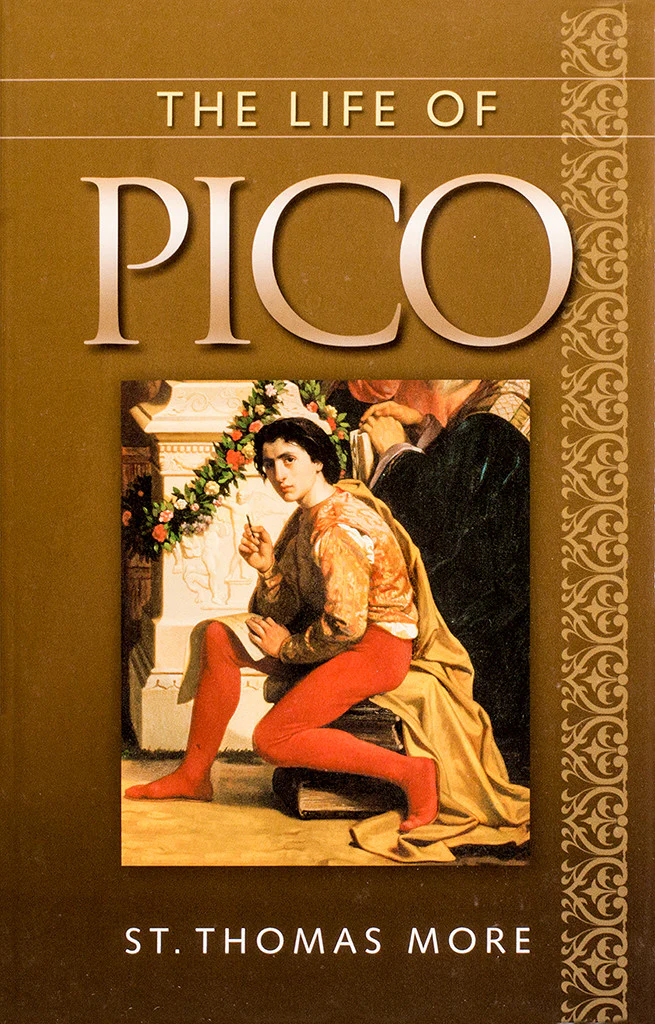
The Life of Pico
Presented to modern readers in English for the first time in 500 years, The Life of Pico by St. Thomas More is a biography of one of the Renaissance’s most famous figures: Giovanni Pico de la Mirandola (1463-94). Given More’s demanding personal spiritual life, one would assume that More wishes to praise a famous and virtuous man. But what emerges from this book is quite different. Pico turns out to be an extraordinarily virtuous, talented, and wealthy man, but a man nonetheless, who is missing something essential. And so More calls Pico “a very spectacle” of virtue.
More sees Pico as very much like himself, as the two turn out to have very similar life experiences. Both carry some scars from difficult or missing relationships with their fathers, both are extremely talented and powerful in their time, and both had been steered toward a religious vocation which they did not embrace.
The book, The Life of Pico, is as much a riddle about More as it is an explanation of Pico. More’s great-grandson and biographer, Cresacre More, claims that Thomas More as a young man, sought to emulate Pico once he decided that his path in life was marriage and not the cloth. The book’s first half contains the abridged account of Pico’s life. The second half is More’s rhymed verse on the 12 rules of spiritual battle, the 12 weapons of spiritual battle, and the 12 properties of a lover, followed by Pico’s prayer to God. In the last analysis, this biography of Pico becomes an exercise in the discernment of true virtue, in the contradictions and difficulties one encounters in the immersion into the world, and at the same time, in the life of God.
Original: $16.95
-65%$16.95
$5.93The Life of Pico
Presented to modern readers in English for the first time in 500 years, The Life of Pico by St. Thomas More is a biography of one of the Renaissance’s most famous figures: Giovanni Pico de la Mirandola (1463-94). Given More’s demanding personal spiritual life, one would assume that More wishes to praise a famous and virtuous man. But what emerges from this book is quite different. Pico turns out to be an extraordinarily virtuous, talented, and wealthy man, but a man nonetheless, who is missing something essential. And so More calls Pico “a very spectacle” of virtue.
More sees Pico as very much like himself, as the two turn out to have very similar life experiences. Both carry some scars from difficult or missing relationships with their fathers, both are extremely talented and powerful in their time, and both had been steered toward a religious vocation which they did not embrace.
The book, The Life of Pico, is as much a riddle about More as it is an explanation of Pico. More’s great-grandson and biographer, Cresacre More, claims that Thomas More as a young man, sought to emulate Pico once he decided that his path in life was marriage and not the cloth. The book’s first half contains the abridged account of Pico’s life. The second half is More’s rhymed verse on the 12 rules of spiritual battle, the 12 weapons of spiritual battle, and the 12 properties of a lover, followed by Pico’s prayer to God. In the last analysis, this biography of Pico becomes an exercise in the discernment of true virtue, in the contradictions and difficulties one encounters in the immersion into the world, and at the same time, in the life of God.
Product Information
Product Information
Shipping & Returns
Shipping & Returns
Description
Presented to modern readers in English for the first time in 500 years, The Life of Pico by St. Thomas More is a biography of one of the Renaissance’s most famous figures: Giovanni Pico de la Mirandola (1463-94). Given More’s demanding personal spiritual life, one would assume that More wishes to praise a famous and virtuous man. But what emerges from this book is quite different. Pico turns out to be an extraordinarily virtuous, talented, and wealthy man, but a man nonetheless, who is missing something essential. And so More calls Pico “a very spectacle” of virtue.
More sees Pico as very much like himself, as the two turn out to have very similar life experiences. Both carry some scars from difficult or missing relationships with their fathers, both are extremely talented and powerful in their time, and both had been steered toward a religious vocation which they did not embrace.
The book, The Life of Pico, is as much a riddle about More as it is an explanation of Pico. More’s great-grandson and biographer, Cresacre More, claims that Thomas More as a young man, sought to emulate Pico once he decided that his path in life was marriage and not the cloth. The book’s first half contains the abridged account of Pico’s life. The second half is More’s rhymed verse on the 12 rules of spiritual battle, the 12 weapons of spiritual battle, and the 12 properties of a lover, followed by Pico’s prayer to God. In the last analysis, this biography of Pico becomes an exercise in the discernment of true virtue, in the contradictions and difficulties one encounters in the immersion into the world, and at the same time, in the life of God.